The leader of a national tea party group today "warned" that should Republican party presidential candidate Mitt Romney win the nomination they will not actively campaign for him.
Judson Phillips of the Tea Party Nation organization, while conceding most Tea Partiers will likely vote for Romney, stated yesterday that "we will not be out there with signs for him or in his campaign," continuing that "Romney has a huge problem with the conservative base of the GOP. He had better do something about that ASAP or he won’t have to worry about that moving to the middle nonsense,” (for full article click here).
Such blunt talk by a leader of a movement partly credited with giving Republicans control over the U.S. House in 2010's historic mid-term elections should give pause to the GOP who desperately need a united party to come together after a bruising primary season if they want to have any hope of defeating Democratic candidate and incumbent President Barack Obama in the General Election Nov. 6.
Such statements as Phillips' also give full view to the deep divisions that have plagued the party in recent years and which this year boiled over in a particularly vitriolic and extended primary season in which at least nine Republicans vied for the nomination and candidates openly attacked one another's level of conservatism, (or lack thereof), in extensive and televised prime-time debates.
And while that number is now officially down to two, (Newt Gingrich and Mitt Romney), most observers, and even Gingrich himself recently, have all but conceded the likelihood of Romney being the inevitable GOP nominee.
The Tea Party Nation leader also cited informal surveys on the Tea Party Nation website indicating that as many as 25% of those who identify with the tea party movement plan on not voting for Mitt Romney if he is, in fact, the Republican nominee.
For such voters, the option of merely "staying home" on election day is more palatable than holding their nose and voting for a candidate whose conservative credentials and commitment to such things as a balanced budget and spending cuts that will eliminate the federal deficit are, at least to them, questionable.
The salient question however is, in doing so, do they tip the scales in Obama's favor and actually end up helping a President who they uniformly despise and who has promoted policies which they find equally, if not more, objectionable?
While such matters are not the focus of our article here, it is certainly appropriate to ask whether the right wing of the GOP, members of which this party has frequently sparred with here and on social media such as Twitter, is unintentionally shooting itself in the foot with such tactics?
More of interest to us and our educational mission here at the ACLP, we thought it appropriate to ask in the aftermath of such statements whether those like Phillips, purists for whom the word compromise seems dirty and seem to eschew the ordinary maxim of politics being the art of incremental change, want "the whole cake and eat it too" regardless of the consequences to our broader body politic.
Over the next week we will examine this idea, not just in relation to the Tea Party but also Ron Paul Supporters, Occupy Wall Street, and other groups which have been active this year and oft-threatened to "take their ball and go home," with the goal our answering this question: Do such threats of political "civil disobedience" evidence a new "purism" that signals the advent of a permanent era in American politics with long-term repercussions which threatens to further unravel our social fabric and prove counterproductive to the very groups that propose such political responses or is it just another side of expected partisanship in an election year that will ultimately prove temporal and benign?
Or, put another way, could such dissatisfaction with the status quo cause a "once in a generation" political "realingment" and foretell a rising of new and heretofore unknown political parties to give full voice to the political beliefs and values of a large swath of the American electorate? Intriguing questions and ones we will endeavor to contemplate, and hopefully answer, in days to come. jp
Showing posts with label Republican Presidential race. Show all posts
Showing posts with label Republican Presidential race. Show all posts
Friday, April 13, 2012


Tuesday, April 10, 2012
Santorum Drops Bid for Presidency, Fails to Endorse Romney
Republican Presidential candidate today announced that he is "suspending" his campaign for the Presidency, in a move which will undoubtedly consolidate Mitt Romney's support and accelerate his efforts to win the Republican nomination. Santorum, shown below, did not however endorse anyone for the Republican nomination, perhaps still feeling the sting of Romney's attacks on television which clearly have taken a toll on his small and relatively underfunded campaign in comparison, which had been beset by family health issues and concerns over his appeal in a general election with his conservative social positions, which many in the GOP feared would unnecessarily turn off independents and a constant focus of attacks and derision from Democratic pundits.
The move puts the focus back on the faltering and now almost nonexistent campaign of former Speaker of the U.S. House Newt Gingrich, who recently indicated tacit, if not overt acceptance of Romney's inevitable nomination. Indeed, in spite of his prior comments, the former Speaker immediately indicated he may not be so quickly endorsing Romney, at least not yet. It remains to be seen if this turn of events, widely expected by political pundits in light of Santorum's inability to win any further major primary contests since his sweep of the South that catapaulted his nascent socially conservative campaign into the national spotlight just a few weeks ago in a season that has seen several Republicans' political fortunes rise and fall as "frontrunners," will change Ginrich's tune (or chances) between now and the GOP convention in August. In light of his recent firing of almost his entire campaign staff and no money in the bank, our guess is that it won't. But another chapter of this years Republican nomination process has ended; sure was fun while it lasted! We wish Senator Santorum the best in his future endeavors. We have a feeling it may not be the last we see of him. NOTE: For full coverage of this event, including video of comments made by Santorum in bowing out, click here.
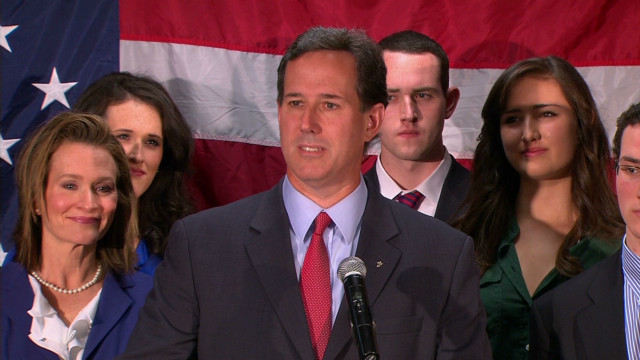
Former Senator Rick Santorum, announcing "suspension" of his campaign for President Tues 4/10/2012
The move puts the focus back on the faltering and now almost nonexistent campaign of former Speaker of the U.S. House Newt Gingrich, who recently indicated tacit, if not overt acceptance of Romney's inevitable nomination. Indeed, in spite of his prior comments, the former Speaker immediately indicated he may not be so quickly endorsing Romney, at least not yet. It remains to be seen if this turn of events, widely expected by political pundits in light of Santorum's inability to win any further major primary contests since his sweep of the South that catapaulted his nascent socially conservative campaign into the national spotlight just a few weeks ago in a season that has seen several Republicans' political fortunes rise and fall as "frontrunners," will change Ginrich's tune (or chances) between now and the GOP convention in August. In light of his recent firing of almost his entire campaign staff and no money in the bank, our guess is that it won't. But another chapter of this years Republican nomination process has ended; sure was fun while it lasted! We wish Senator Santorum the best in his future endeavors. We have a feeling it may not be the last we see of him. NOTE: For full coverage of this event, including video of comments made by Santorum in bowing out, click here.
Former Senator Rick Santorum, announcing "suspension" of his campaign for President Tues 4/10/2012
Tuesday, March 27, 2012
Does the GOP nominating Romney "give up" health care issue for Conservatives?
We've all heard the narrative-- repeated insistently by Rick Santorum in the primary battle he is currently waging for the presidential nomination in the Republican party-- that if the GOP nominates Mitt Romney to face Obama in the Nov. 6, 2012 general election the issue of Obamacare will be “taken off the table,” or at least opposition to the unpopular “individual mandate” much debated in the Supreme Court this week will be less effective. Indeed, it is a position that this party at one time gave credence to. But after listening to the last few days of Supreme Court arguments, one has to ask, is the premise underlying this narrative really true? Will the issue of health care truly be “lost” and conservatives somehow be weakened in their attack on the Obama Administration's signature domestic policy achievement that was forced through in the dead of night by a lame duck Congress with much manipulation and cajoling, (as noted by some of the justices this week), if Romney is the Nominee? While I have already dealt with the differences between Obamacare and Romneycare in my rebuttal to Phil. A. Klein's critique of Ann Coulter's editorial “Three Cheers for Romneycare,” (see here), and will attempt to not waste time repeating all those points here, further reflection on the critical issue at hand has convinced me that the answer to this question is clearly “no.”
I share my thoughts not to open yet another fissure in the conservative movement of the many that have become evident in the contentious primary process we have witnessed, but rather to bring a sense of perspective (and closure?) that seems sorely lacking in the heat of partisan battles.I also realize that there are honest, differing perspectives on this among conservatives. But with the intention to help conservatives avoid making a decision that could lead to even more catastrophic results, (as will hereinafter be made clear) I must share my heart on this subject. So what exactly is it, especially in light of my personal fondness for Rick Santorum's campaign previously, that has brought me to this most recent conclusion?
For starters, the narrative pushed by the Santorum campaign, and conservative supporters generally, is based on a faulty assumption: Namely, that the “Obamacare” issue will be as salient in Nov. (and our nation's future), as it is now. For several reasons we believe it will not be so.
First, in light of the open skepticism of the Supreme Court regarding the federal mandate contained in Obamacare-- and the lukewarm support of even some of the more liberal justices on the High Court-- we firmly believe that the “Patient protection and Affordable Care Act” (as it's formally named) will, in fact, be struck down, in whole or in part, by the Court (and resoundingly so).
We believe this will have at least two effects: 1) It will invigorate left of center voters to go to the polls who are not likely to be favorably disposed to Rick Santorum's brand of social conservatism, and 2) It will depress voter turnout of those conservatives who might most naturally tend to favor the candidate who has most closely tied his fortunes to opposition to mandates generally, Rick Santorum.
But why is this so? Simply for this reason: After all the brohouha over mandates that has embroiled the Republican primaries, and raised conservative concerns, (rightly so), over the effect on our Republic and Constitution of the federal mandate contained in Obamacare, any decision striking it down by the Supreme Court-- which the justices have widely indicated will come by summer-- will accordingly reduce the urgency of the issue in the Nov. general election. As a result, though not by any means all, some conservatives for whom this is THE burning, penultimate issue in the elections might stay home, (thus hurting Santorum's chances if he is the Republican nominee). Of course, as any astute student of politics knows, turnout is key in a close election, (which make no mistake, this election will be!)
On the other hand, Mitt Romney is far more likely to pull not just Republican voters, but independents and undecideds, (who in the Illinois primary recently, an election which demographically more closely approximates the general electorate, broke in large margins for Romney). Indeed, there are a lot of different reasons general election voters might vote for Romney, none of which have to do with Obamacare, (which as we've said, will already be “done and decided” come Nov. 6).
Secondly, as the price of gas rises amidst continued fears of global unrest and the Iranian situation, we believe “bread and butter” issues like jobs and the economy will dominate voters concerns in Nov.
Now don't get us wrong. We believe so called “social issues” are critically important as a part of the GOP's pro-family platform. However, we believe economic and other concerns will, as polls now show, continue to dominate the minds of the broader electorate that will be voting in the general election in November. For reasons as have been previously expressed by us as well as others, we believe this not only favors the nomination of a proven business “outsider” such as Mitt Romney, but it could critically also “insulate” and protect Romney's ability to press the issue of health care notwithstanding his passage of what many consider the “blueprint” for Obamacare, his state-passed “Romneycare” while governor of Mass.
The controversy over this issue, as well as the differences between Romneycare and Obamacare, have already been well documented, and for our purposes here will not need to be repeated, (suffice to say that there is a huge difference between a complete federal takeover of health care and more localized solutions arising from the “laboratory of the states” to deal with the problems associated with rising health care costs that will undoubtedly be highlighted in the Supreme Court's imminent decision).
But saliently, and as even acknowledged by “Romneycare's” harshest critics, the States undoubtedly have the power under the Tenth Amendment-- or at least aren't proscribed by the federal constitution-- to impose all sorts of “mandates,” (including ones relating to health care) at the State level by virtue of a State's inherent “police powers” in the general interest of public health and safety, (and for those libertarians who disagree with this fundamental concept we ask if you also disagree that the State can regulate alcohol sales or require you to buy car insurance? Of course, and as an aside, the Santorum campaign's repeated pounding of an “anti-all-mandates” drum belies an inherent contradiction in believing such matters as contraception can be regulated by the State while failing to explain why matters of health care cannot, but I digress).
Again, lest any misunderstand, we are not saying that we, as an organization, favor even the less intrusive-- and constitutional, at least from a federalism standpoint-- state mandate to purchase health insurance found in Romneycare, (indeed, to focus on this is to miss the point of our focus on politics begun in our prior post).
Rather, and more salient to our discussion here, we simply believe that in the hearts and minds of general election voters, Romney's previous position on record as doing something about healthcare will help, rather than hurt him, in ways that are not true with Rick Santorum.
Indeed, we believe Romney's previous attempts at insurance/health reform at the state level in Mass. will actually insulate him from one of the President's chief attacks leading up to the Nov. elections, specifically the one that goes like this: When it comes to the important issue of health care “reform” Republicans are “do nothings” who can only obstruct and have no ideas of their own to help people with the rising cost of health insurance, (which regardless of the Supreme Court's decision will continue to be an issue due to advanced technology and demographic trends pushing up the price of health care services).
This, to us, will likely be a far more salient issue (and likely line of attack of the Democrats), in November, especially when it will be coming, as now widely expected, after the Supreme Court strikes down Obamacare.
Not so with Rick Santorum, who will easily be painted by the White House as an “extreme obstructionist” that can only feed the narrative and effectiveness of Obama's attack on Republicans as the party of “do nothings” when it comes to health care, (to say nothing of Santorum's stance on social issues, which personally we rather like but when combined with the expected liberal backlash on the striking down of Obamacare will result in an extremely unified and motivated Democrat party at a time when due to lingering bitterness over extended primary battles Republicans may be less so).
Indeed, in such a “post Obamacare” political environment we think it will rather be Romney, not Santorum, whose political position is most strengthened by this turn of events.
As alluded to above, not only would it completely insulate Romney from the repeated attacks of President Obama that Republicans are happy “doing nothing” on the important issue of health care, but coming on the heels of the expected reversal of the unpopular federal law Romney will be able to exhibit leadership and an understanding of federalism by saying convincingly, “This is why such matters need to be made at the State and not federal level like I did in Mass.” (Indeed, re: the latter we would not be at all surprised if part of the Supreme Court's decision highlights this fundamental federalism of our constitution vis a vis a focus on the differences in the lawfulness of State vs. Federal mandates inherent in the Tenth Amendment, further buttressing Romney as opposed to Santorum who has publicly thrown in fully against any and all mandates).
Remember, elections can be won or lost on the slightest of impressions, and the one emerging from this turn of events clearly would buttress one surrounding Romney's strengths stemming from his business and Olympics experience, that of executive leadership.
Moreover, as pointed out in our rebuttal of Mr. Klein's anti-Coulter piece, in light of the fact that Romney's state “mandate” setting up market-based exchanges where insurance companies competed for the business of individual consumers stopped the Democrats from imposing an even more instrusive “single payer” government run insurance system in Massacheussets, it also adds an element of wisdom and executive effectiveness in working with both parties to Romney that is sorely lacking in Santorum's candidacy. (Indeed, it strenghthens the Romney narrative that he is a “get it done” outsider from the world of business, quite unlike the “lifelong politician” model which voters have increasingly soured on).
Such considerations and ability to counter the big government ideas of obvious statists become even more important when one considers that Democrats, if able to wrest control of the House of Representatives from Republicans on the enthusiasm of their base post Obamacare's unconstitutional demise, are likely to impose in its place an even more intrusive “single payer” system if Obama is reelected by simply expanding medicaid to all, (a government program that has already been deemed constitutional and would be immune to the sort of legal challenges currently being made against Obamacare). Such an outcome would be like going from the frying pan into the fire for conservatives, and have a far more devastating impact upon individual liberty and the free market than Obamacare, (which, for all its flaws, at least preserves the vestiges of a free market system).
It also bears considering that the above “doomsday” scenario for conservatives of the Democrats regaining control of the House from Republicans-- who currently hold a slim majority-- a prospect which polls show is significantly more likely if a polarizing candidate with less “coattails” like Santorum is the Republican nominee in the general election. Indeed, polls consistently show that Romney is more acceptable to a wide swath of voters “in the middle,” (you know, the ones who actually decide national elections?)
Even more important is the U.S. Senate, where any negative downticket conseqences to our nominee could cost us chances to regain control over the critical task of judicial oversight and confirmation of judges to the federal judiciary, (including the Supreme Court itself, where matters such as the future of the fateful and anachronistic Roe v. Wade decision and Gay marriage enshrined as a “right” in the federal constitution will be decided).
Assuming the worst case scenario of both a Presidential and Senate setback for conservatives, that would leave President Obama and his leftist supporters the chance to fill as many as three Supreme Court vacancies with those who share his progressive vision of law and the Constitution and the potential to set back any conservative gains that we make at both the federal and state legislative level, (witness the California Supreme court's overturning the clear will of the voters to support marriage as one man and one woman which, even if review of said decision was granted by the U.S. Supreme Court, is doubtful we would have the votes to prevail); in short, even on social issues, (the one area where Santorum potentially trumps Romney's “conservative cred”), it could open a pandora's box of mischief and immorality that would make Santorum himself blush, (which admittedly, might not be too hard if it is true he almost "threw up" on hearing a speech by JFK on the 'separation' of church and state, a matter not at issue here). In this regard it is irrelevant that we may personally like Santorum's strongly “conservative” stand on social policy issues, (as well as his emphasis on manufacturing); the fact remains that his defeat as a general election candidate would potentially do far more damage to the conservative position on such issues than he could possibly further if elected as President.
Moreover, and in terms of basic electability, it is indisputable that among almost all demographic groups, (including the critical ones of women and independents as a whole), Romney retains a significant advantage; In short, if Santorum wins the GOP nomination for President it could have significant “downticket” consequences which leads to Democratic control of the Congress. And if that happens, if will make any conservative victory on Obamacare in the Supreme Court in a few months a distant and insignificant battle in a much larger war we can not risk losing.
I began this article with the primary purpose of debunking the oft-repeated idea that Mitt Romney's passing of “Romneycare” as governor in Mass makes him a less effective or desirable candidate for President in the general election to oppose President Obama compared to Rick Santorum, and have covered a lot of ground, (much more so than I intended when I began).
Hopefully some of the points I have raised will begin a much bigger conversation amongst conservatives leading up to this critical national election, or we may be stuck with suffering the collateral consequences for a much larger time to come, and on a much larger scale, than we can now envision. Jp
Tuesday, February 14, 2012
Has the Republican Party been taken over by Ron Paul Libertarianism?- An analysis of the causes, history, and effects of the GOP's Libertarian Streak
In the course of following-- or attempting to follow-- the crazy ups and downs of the near fratricidal intra-party war currently being waged in the Republican primary for which candidate will be the party's standard bearer to go against Barack Obama in the Fall, one thing has become increasingly clear, or maybe two. There are deep fissures of division among the parties core constituencies, with each passionately devoted to their policies and version of the truth vis a vis what they think it will take to defeat the sitting Democratic President in November.
In this regard there are none for whom this is more true than Ron Paul supporters, who in spite of few victories thus far in the campaign, and even fewer delegates, clearly compensate by sheer determination and enthusiasm for their cause. We thus thought it appropriate to take a moment and examine this core component of the modern Republican party in light of a few key considerations, 1) The history and roots of Libertarianism (in the Gop and nationally), 2) The effects within the party with an emphasis on primary and general election politics, and, 3) The potential consequences of Ron Paul Libertarianism upon national policy as expressed in social, economic and foreign policy.
The Libertarian "wing" of the Republican party makes up one of three key groups making up the bulk of the Republican base today, the other two being the Christian or cultural conservatives and so-called "Establishment" or "country club" Republicans. And while the Libertarians certainly agree with the other two "legs" of the Republican stool, if you will, on the need to defeat President Obama to meet party goals and reverse various national policies and objectives of the Obama Administration which they view as destructive to our economy and very way of life, they differ markedly in both the specific policies they view as most destructive as well as their level of enthusiasm and dedication to the party in general. As this author can personally attest, this has sometimes resulted in a seeming unwillingness and/or or inability of the those on the extreme end of the Libertarian wing to "play nicely" with the other wings in the GOP, and has led in the eyes of the other two legs, fairly or not, to a perception that the Libertarian wing has a "take their ball and go home" attitude not conducive to party unity and the ability to come together for common goals necessary to achieve electoral success. Of course, this could perhaps be equally said of any of a major party's key groups, and in the case of the GOP could perhaps equally apply to the Cultural converservatives for whom "social issues" are most important, or the "establishment Republicans" for whom stability and an emphasis on free market economics is most important. However, those wings of the GOP are not currently the subject of this article. Rather, this post shall examine the history of the Libertarian movement in general and within the GOP, the reality of the perceptions often associated with and the practical effect upon the party, i.e., how it helps, or hurts, in our humble opinion, the GOP's overall chances to win, (and as an aside, Ron Paul's chances at the nomination).
For starters, as alluded to above, the Libertarian wing is easily a contender, along with the Christian/cultural conservative wing of the GOP, for the most enthusiastic group in the party. Many have noted that the Libertarian movement, and the youthful and energetic "fresh blood" that it brings into the party, is critical to the Republicans' success in the kind of campaigning and "street level" politics that provide energy and awareness among the general public in a way that is helpful to the party and its nominee leading up to the General election. However, there is a darker side, a "cost" if you will of their particular brand of politics as well, one which this article will examine in detail. To do that we must delve into Libertarianism's beginnings.
The national and political history of American Libertarianism
American Libertarianism has its roots in American politics going back to the nation's founding.
The philosophical underpinnings of American Libertarianism
In this regard there are none for whom this is more true than Ron Paul supporters, who in spite of few victories thus far in the campaign, and even fewer delegates, clearly compensate by sheer determination and enthusiasm for their cause. We thus thought it appropriate to take a moment and examine this core component of the modern Republican party in light of a few key considerations, 1) The history and roots of Libertarianism (in the Gop and nationally), 2) The effects within the party with an emphasis on primary and general election politics, and, 3) The potential consequences of Ron Paul Libertarianism upon national policy as expressed in social, economic and foreign policy.
The Libertarian "wing" of the Republican party makes up one of three key groups making up the bulk of the Republican base today, the other two being the Christian or cultural conservatives and so-called "Establishment" or "country club" Republicans. And while the Libertarians certainly agree with the other two "legs" of the Republican stool, if you will, on the need to defeat President Obama to meet party goals and reverse various national policies and objectives of the Obama Administration which they view as destructive to our economy and very way of life, they differ markedly in both the specific policies they view as most destructive as well as their level of enthusiasm and dedication to the party in general. As this author can personally attest, this has sometimes resulted in a seeming unwillingness and/or or inability of the those on the extreme end of the Libertarian wing to "play nicely" with the other wings in the GOP, and has led in the eyes of the other two legs, fairly or not, to a perception that the Libertarian wing has a "take their ball and go home" attitude not conducive to party unity and the ability to come together for common goals necessary to achieve electoral success. Of course, this could perhaps be equally said of any of a major party's key groups, and in the case of the GOP could perhaps equally apply to the Cultural converservatives for whom "social issues" are most important, or the "establishment Republicans" for whom stability and an emphasis on free market economics is most important. However, those wings of the GOP are not currently the subject of this article. Rather, this post shall examine the history of the Libertarian movement in general and within the GOP, the reality of the perceptions often associated with and the practical effect upon the party, i.e., how it helps, or hurts, in our humble opinion, the GOP's overall chances to win, (and as an aside, Ron Paul's chances at the nomination).
For starters, as alluded to above, the Libertarian wing is easily a contender, along with the Christian/cultural conservative wing of the GOP, for the most enthusiastic group in the party. Many have noted that the Libertarian movement, and the youthful and energetic "fresh blood" that it brings into the party, is critical to the Republicans' success in the kind of campaigning and "street level" politics that provide energy and awareness among the general public in a way that is helpful to the party and its nominee leading up to the General election. However, there is a darker side, a "cost" if you will of their particular brand of politics as well, one which this article will examine in detail. To do that we must delve into Libertarianism's beginnings.
The national and political history of American Libertarianism
American Libertarianism has its roots in American politics going back to the nation's founding.
The philosophical underpinnings of American Libertarianism
Tuesday, November 8, 2011
Allegations of Sexual Misconduct against GOP Presidential hopeful Herman Cain Mount
Mounting allegations against Republican presidential hopeful Herman Cain have roiled the Republican Presidential nomination process, leading to speculation that the candidate's stunning rise in the polls may be followed by an equally devastating fall from grace within the Republican (and American) electorate even as he has steadfastly resisted calls to drop out of the nomination race.
Although recent polls have not yet seemed to register much of a change in opinion among Republicans towards the embattled candidate following his staunch denials of allegations that he sexually harassed several female employees of the National Restaurant Association in the late '90s when he was President of the organization, that is likely to change with Sharon Bialek, one of the alleged harassed women, now coming forward to publicly air lurid details of his attempted advances and use of employment as leverage in attempts to procure sexual favors, see here.
And although as a non-profit organization we don't often publicly express opinions on purely political matters better left to the judgment of the American voters (as opposed to examination of the issues), and don't usually endorse particular candidates, these extraordinary events lead us to make the following statement:
1) With the publicly detailed allegations now given increased credibility, as well as yielded publicly the name of a second woman and U.S. treasury department spokesperson Karen Kraushaar, also allegedly harassed by Cain, raising the likelihood of further revelations to come, (indeed, news has broken that a planned news conference of all the women claiming harassment by Cain in the 1990's is planned), AND,
2) The revelation by the Candidate himself that at least one of the woman claiming harassment was paid a "severance pay" to drop her claims of sexual harassment in the '90s and the National Restaurant Association has confirmed the existence of at least 2 such complaints against Mr. Cain, and WHEREAS,
3) It appears highly likely to this organization that dragging this matter out will prove not in the interest of all parties, (including the women involved in these incidents, several of which have expressed a desire not to have the whole thing made public), and further focusing on such matters will only serve to contribute to the cynicism and low esteem in which the American public already holds their elected leaders and political institutions and can at this point serve no legitimate law enforcement purpose these many years later long after the statute of limitations on any civil or criminal action can be brought have expired, AND FURTHER,
4) That a continuation of Herman Cain's presidential campaign can only harm and reinforce by association, fairly or not, in the eyes of a significant portion of the public, a negative view towards conservative principles and other candidates who might otherwise better be able to promote policies more in keeping with the values and goals of the ACLP than the present Administration, MOREOVER,
5) That further scheduled debates, one of which is scheduled for November 9, 2011 on CNBC, is likely to focus considerably on the claims as have been made against Mr. Cain and thus serve as a distraction to the discussion of the critical public policy issues facing the nation at this time, NOW THEN,
The American Center for Law and Policy calls on Republican Presidential Candidate Herman Cain to suspend and/or end his campaign for President of the United States and put his country's need to focus on the critical issues it faces in these uncertain times above his own political aspirations.
Indeed, to do so would allow a time of healing and reflection that would innure to the benefit of the country and good will of all Americans and positively reflect on the character of Mr. Cain that, prior to the recent revelations, had been so much a part of the appeal of his campaign for the Republican nomination to the presidency. (After all, even Nixon had the decency to resign rather than put the country through a grueling and extended impeachment process that would have only served to further divide our country at a time in which, as now, our attentions could be better focused elsewhere, for instance, Iran, or the world economy).
On a more personal note, we also urge you Mr. Cain to seek personal redemption and reconciliation for the matters of which have been reported on which will undoubtedly require your attention in your own life regardless of whether the offenses claimed have been exhaturated and/or promoted for partisan political purposes as you claim.
We also call on all other Republican candidates for the presidential nomination to condemn, in no uncertain terms, the kind of acts as are alleged and have been reported widely in the media, as several have already moved in the direction of doing so, (see comments by Newt Gingrich and Rick Santorum).
The issue of sexual harassment is a very serious one, as are the issues that further focus on the sensational claims as have been made against Mr. Cain will undoubtedly crowd out from public consideration if the allegations as have been made persist in dominating public discourse as they have the last week in the next.
We therefore appeal to you personally Mr. Cain, to do the right thing and step down from consideration for the nomination to the office of President so that a comprehensive and dispassionate examination of the relevant and crucial issues facing our nation may be able to move forward and ultimately innure to the general welfare of these United States. jp
Although recent polls have not yet seemed to register much of a change in opinion among Republicans towards the embattled candidate following his staunch denials of allegations that he sexually harassed several female employees of the National Restaurant Association in the late '90s when he was President of the organization, that is likely to change with Sharon Bialek, one of the alleged harassed women, now coming forward to publicly air lurid details of his attempted advances and use of employment as leverage in attempts to procure sexual favors, see here.
And although as a non-profit organization we don't often publicly express opinions on purely political matters better left to the judgment of the American voters (as opposed to examination of the issues), and don't usually endorse particular candidates, these extraordinary events lead us to make the following statement:
1) With the publicly detailed allegations now given increased credibility, as well as yielded publicly the name of a second woman and U.S. treasury department spokesperson Karen Kraushaar, also allegedly harassed by Cain, raising the likelihood of further revelations to come, (indeed, news has broken that a planned news conference of all the women claiming harassment by Cain in the 1990's is planned), AND,
2) The revelation by the Candidate himself that at least one of the woman claiming harassment was paid a "severance pay" to drop her claims of sexual harassment in the '90s and the National Restaurant Association has confirmed the existence of at least 2 such complaints against Mr. Cain, and WHEREAS,
3) It appears highly likely to this organization that dragging this matter out will prove not in the interest of all parties, (including the women involved in these incidents, several of which have expressed a desire not to have the whole thing made public), and further focusing on such matters will only serve to contribute to the cynicism and low esteem in which the American public already holds their elected leaders and political institutions and can at this point serve no legitimate law enforcement purpose these many years later long after the statute of limitations on any civil or criminal action can be brought have expired, AND FURTHER,
4) That a continuation of Herman Cain's presidential campaign can only harm and reinforce by association, fairly or not, in the eyes of a significant portion of the public, a negative view towards conservative principles and other candidates who might otherwise better be able to promote policies more in keeping with the values and goals of the ACLP than the present Administration, MOREOVER,
5) That further scheduled debates, one of which is scheduled for November 9, 2011 on CNBC, is likely to focus considerably on the claims as have been made against Mr. Cain and thus serve as a distraction to the discussion of the critical public policy issues facing the nation at this time, NOW THEN,
The American Center for Law and Policy calls on Republican Presidential Candidate Herman Cain to suspend and/or end his campaign for President of the United States and put his country's need to focus on the critical issues it faces in these uncertain times above his own political aspirations.
Indeed, to do so would allow a time of healing and reflection that would innure to the benefit of the country and good will of all Americans and positively reflect on the character of Mr. Cain that, prior to the recent revelations, had been so much a part of the appeal of his campaign for the Republican nomination to the presidency. (After all, even Nixon had the decency to resign rather than put the country through a grueling and extended impeachment process that would have only served to further divide our country at a time in which, as now, our attentions could be better focused elsewhere, for instance, Iran, or the world economy).
On a more personal note, we also urge you Mr. Cain to seek personal redemption and reconciliation for the matters of which have been reported on which will undoubtedly require your attention in your own life regardless of whether the offenses claimed have been exhaturated and/or promoted for partisan political purposes as you claim.
We also call on all other Republican candidates for the presidential nomination to condemn, in no uncertain terms, the kind of acts as are alleged and have been reported widely in the media, as several have already moved in the direction of doing so, (see comments by Newt Gingrich and Rick Santorum).
The issue of sexual harassment is a very serious one, as are the issues that further focus on the sensational claims as have been made against Mr. Cain will undoubtedly crowd out from public consideration if the allegations as have been made persist in dominating public discourse as they have the last week in the next.
We therefore appeal to you personally Mr. Cain, to do the right thing and step down from consideration for the nomination to the office of President so that a comprehensive and dispassionate examination of the relevant and crucial issues facing our nation may be able to move forward and ultimately innure to the general welfare of these United States. jp
Subscribe to:
Posts (Atom)